



In early April, a small group of brokerage leaders sat down for a facilitated Mastermind session. No product demos. No vendor pitches. Just an honest conversation about what’s actually happening inside their businesses right now.
What came out of that room was more candid than we expected, and more consistent than anyone would have guessed.
Who was in the room
The group represented a cross-section of the industry: regional independents, franchise owners, franchisors, and leaders running luxury market operations across the country. Different business models, different geographies, and very different scales. But as the conversation began, the distance between their experiences shrank fast.
That convergence was the first thing that stood out. The challenges aren’t niche. They aren’t local. They are structural and shared.
What the conversation was really about
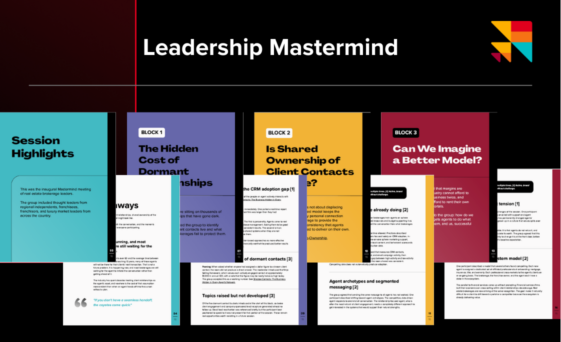
The session covered three areas: dormant relationships and what they’re actually costing brokerages, whether shared ownership of client contacts is even possible, and what a better operating model might look like going forward.
Those sound like familiar topics. What made this different was the level of specificity. People weren’t talking in generalities. They were sharing what had worked, what had failed, and in a few cases, what had already cost them.
One exchange centered on agent retirement and what happens to client relationships when a high-producer exits without a plan in place. One participant from a regional independent described it plainly: “If you don’t have a seamless handoff, the coyotes come quick.”
The room had real stories here, not hypotheticals.
The takeaway from this exchange was particularly pointed. If you don’t have a structured handoff process in place before an agent leaves, the business doesn’t wait for you to figure it out. A consensus quickly formed within the group to identify agents approaching retirement and to initiate a conversation about how they planned to monetize their book of business. For those looking for a starting framework, Nick Krautter‘s The Golden Handoff outlines a structured, referral-based approach to transitioning client relationships that several brokerages have already put into practice.
With roughly 40% of active agents over 60, and the average homeowner now staying in their home for nearly 12 years, this is a math problem that’s already producing consequences.
A few things that landed hard
One of the more striking moments came when the group talked about CRM adoption and the gap between who agents actually know and who ends up in the system. The data Cloze shared, that roughly 88% of the people an agent actively interacts with never make it into the CRM, landed with immediate recognition. One participant pulled a report during the session and found their own gap was larger than they remembered.
“We have been training agents to do something we should have been doing for them all along. The agents leaning into sphere marketing see anywhere from a 25% to 40% bump in their business. You would think that would be compelling to others. It isn’t.”
The group agreed that there were hardly any silver bullets for such a pervasive challenge, but regular reporting, nightly in one case, to sales managers and feedback loops to the agents could incrementally move the needle one agent at a time.
We disconnected the brokerage’s value from compensation
The conversation that generated the most energy was the one about what brokerages have lost by competing on splits for the past 40 years. One participant offered a four-decade perspective on how the rise of high-split models has permanently changed what agents expect from the brokerage relationship.
“We broke something in the 80s, and we are still paying for it. We know we don’t have the highest splits, and we’ll never have the highest splits. We also know we have the highest support. Getting agents to place a monetary value on that support is the battle we fight every day.”
The group agreed on something important. Once the expectation is present, it is very hard to reverse. The best opportunity to change it is before an agent ever develops a baseline assumption about what support should cost.
That conversation didn’t resolve cleanly. It wasn’t supposed to. But the clarity about where the leverage point is and how narrow that window is was something several people cited as a genuine insight.
Why this format works
Most brokerage roundtables are either disguised sales pitches or unstructured networking where the loudest voice dominates. This was neither. It wasn’t a panel. It wasn’t a conference presentation. There were no prepared remarks and no slides to hide behind.
The format was deliberate: A small group, peer-level candor, and a structured conversation that kept building on itself. That produced something that’s hard to replicate in larger formats: Specificity. So rather than “we’re working on agent retention”, we heard exactly what was tested and why it didn’t work. The participants left with a 16-page summary of our discussion and specific actions they would take to do things differently, not just things to think about.
That’s the standard we’re trying to hit each time. If it sounds like something you’d find valuable, we’d like to have you in the next one, which we’re planning for July. The group will continue to be small by design. If you run or serve on the leadership team of a mid-to-large operation and want to be considered for a future session, reach out and let us know.