


Real estate agents are getting older and leaving the business faster than ever. When they go, they leave behind thousands of past clients—people who once trusted your brokerage. We call these “orphaned clients.”
Here’s why this matters: 40% of seasoned agents indicate that more than half of their business comes from people who already know and trust an agent (NAR, 2025). When an agent retires or quits without a plan, those relationships disappear. Your brokerage loses the chance to serve those clients again.
This article explains why orphaned clients are increasing, where to find them, and four strategies to reconnect with them.
The rising tide of orphaned clients
The real estate industry doesn’t talk enough about what happens when agents walk away. Some retirees choose to leave after decades of loyal service. Others burn out or drift into different careers. A growing number quietly disengage: They keep their license active but no longer really work the business.
For brokerages, the consequences aren’t just recruiting headaches or gaps in production. The real loss is relationships.
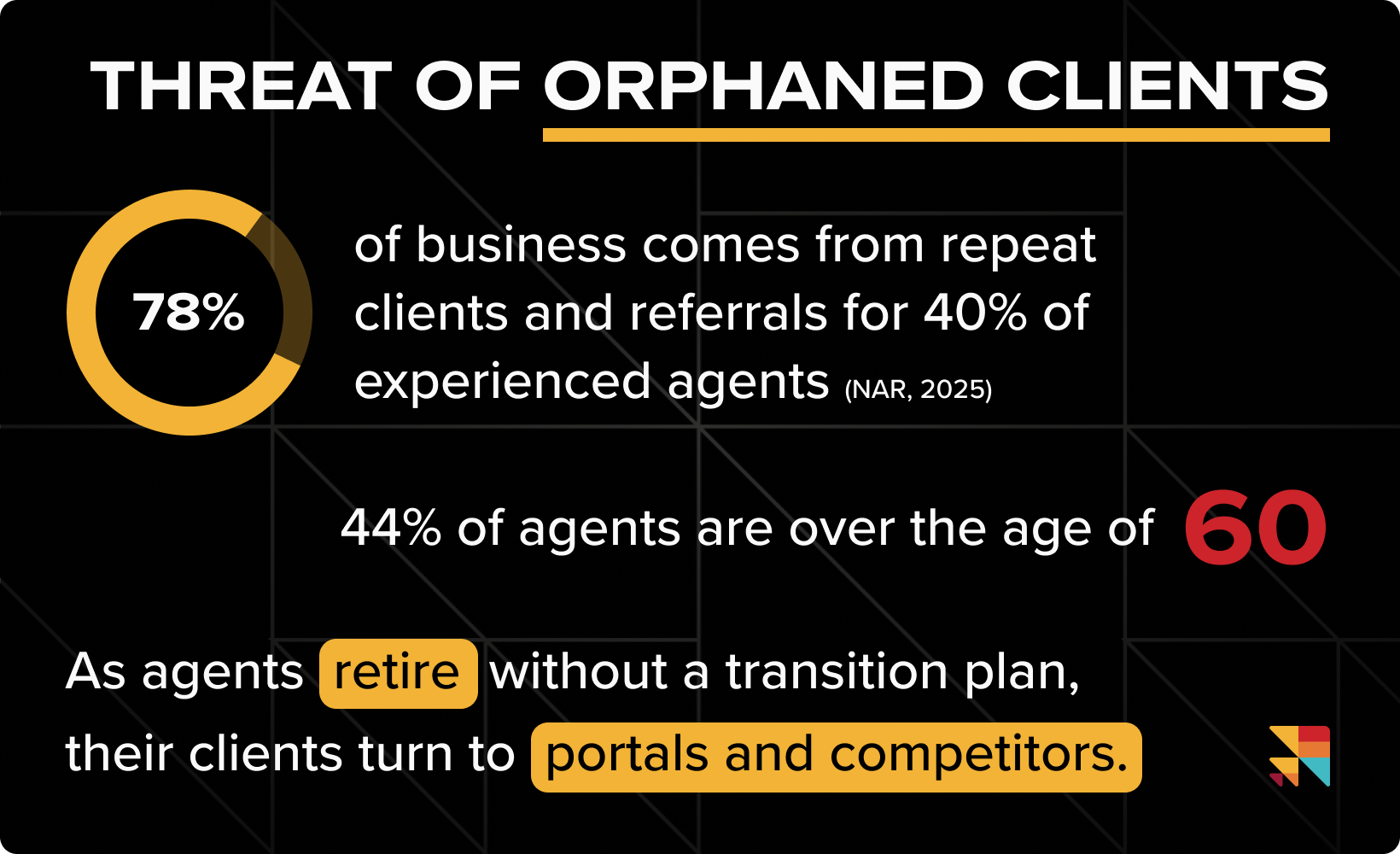
With the median age of REALTORS® hovering at 57 (and 44% over age 60), a wave of clients is being left without their trusted advisor.
This matters because the core of a brokerage’s value isn’t just the brand, the office, or the tools. It’s the relationships. According to NAR’s 2025 Member Profile, repeat clients make up more than half of the business for 40% of experienced agents, while referrals make up another 28%. These are people who already know, like, and trust the agent. When approached as a partner, they trust the brokerage too.
When agents exit without a plan, orphaned clients don’t just fade away. Some drift into the open arms of competitors. Others get picked up by portals that have mastered the art of capturing unclaimed relationships.
I once spoke to a retiring agent, Susan, with the same brokerage for 23 years. Though not a recent top producer, her clients adored her. Her business, built since the 1990s, spanned generations of families she helped buy, move, and downsize. Her biggest worry was her clients’ care after retirement. Without a transition system, years of trust would vanish when she surrendered her license.
This story carries over every time an agent retires or leaves the firm. In fact, most brokerages already have thousands of dormant relationships. Closed transactions sit in old records and databases, and contacts are left untouched for years.
Legacy brokerages are sitting on a goldmine. They claim longevity as a differentiator, but often treat decades of records as archives rather than active assets.
The challenge isn’t acquiring more leads. It’s reawakening the value that’s already on your books.
Defining orphaned clients
Let’s be clear: orphaned clients aren’t just “old files.” They’re people. Families. Homeowners who once trusted your brokerage enough to handle one of the biggest transactions of their lives.
An orphaned client is anyone who bought or sold with one of your agents and then got left behind when that agent retired, switched brokerages, or simply stopped showing up.
The risk is obvious. When the trusted connection disappears, so does the relationship.
Brokerages rely on agents to maintain those connections. When an agent’s connection is gone, so is the brokerage’s. You lose the repeat transaction, the referral, and the chance to be the one they call when life changes.
According to Redfin, the average American homeowner now stays in their home 11.8 years. Almost twice as long as they were in the early 2000s. Picture a first-time buyer who worked with your firm 10 years ago. They’ve raised kids in that home, built equity, and are ready to downsize, but their agent is gone.
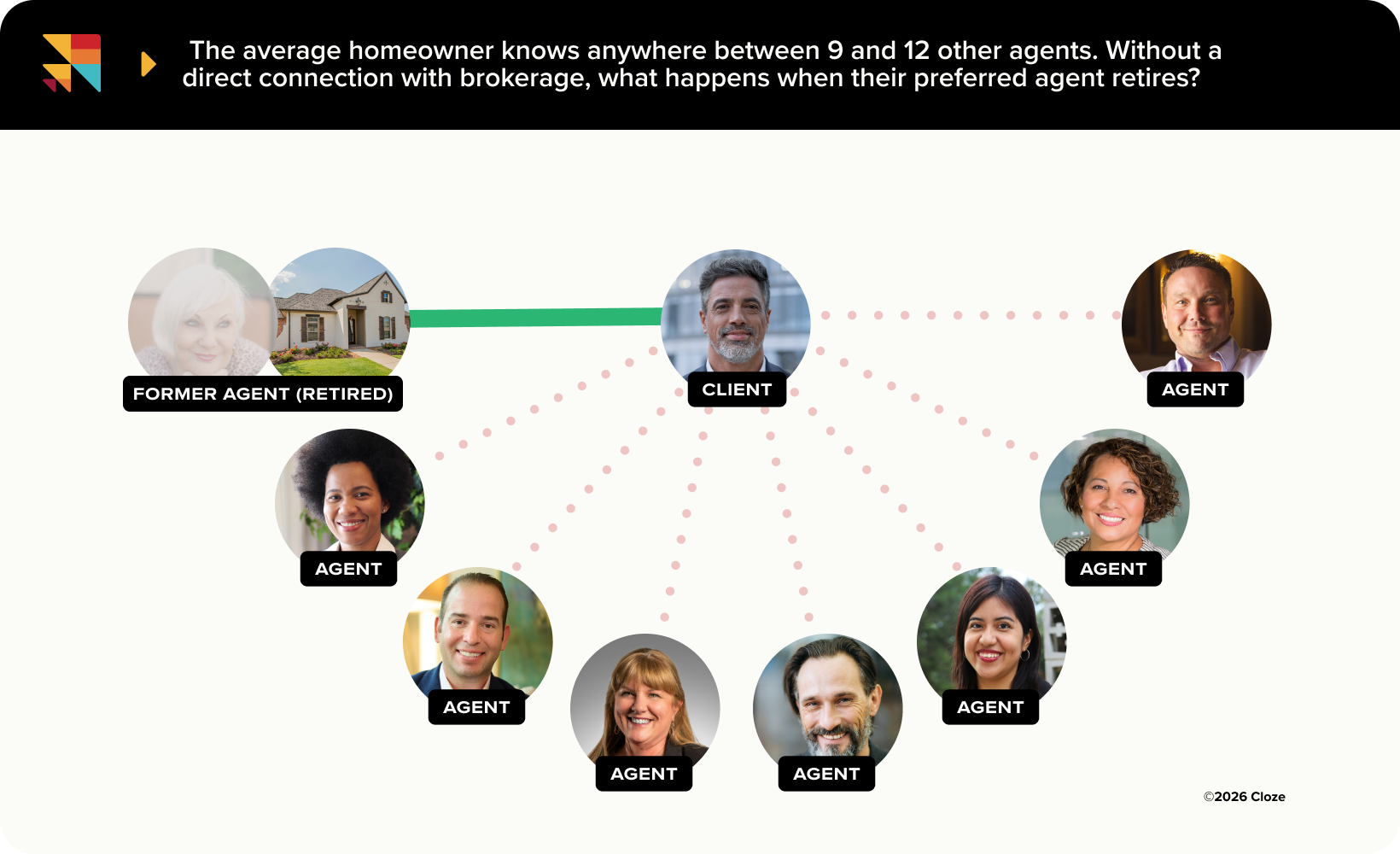
Many industry experts suggest that the average homeowner knows anywhere between 9 and 12 other agents. This makes your disappearing agent an easily replaceable commodity. If your brokerage hasn’t kept that connection fresh, they’ll likely list with whoever shows up in their inbox or mailbox first. Often that’s a competitor or a portal.
Brokerages need to create a plan to protect against clients being orphaned. This kind of plan—often managed through a relationship co-ownership model—is about continuity and making sure that the people who have already chosen your brand don’t feel abandoned the second time around. This kind of model protects the agent’s legacy while safeguarding the brokerage’s long-term financial interests.
Where to find orphaned clients
Orphaned clients aren’t hiding. They’re sitting in plain sight. They lie dormant in systems, files, and memories that brokerages often treat as clutter rather than capital. The opportunity lies in reclaiming them before competitors or portals do.
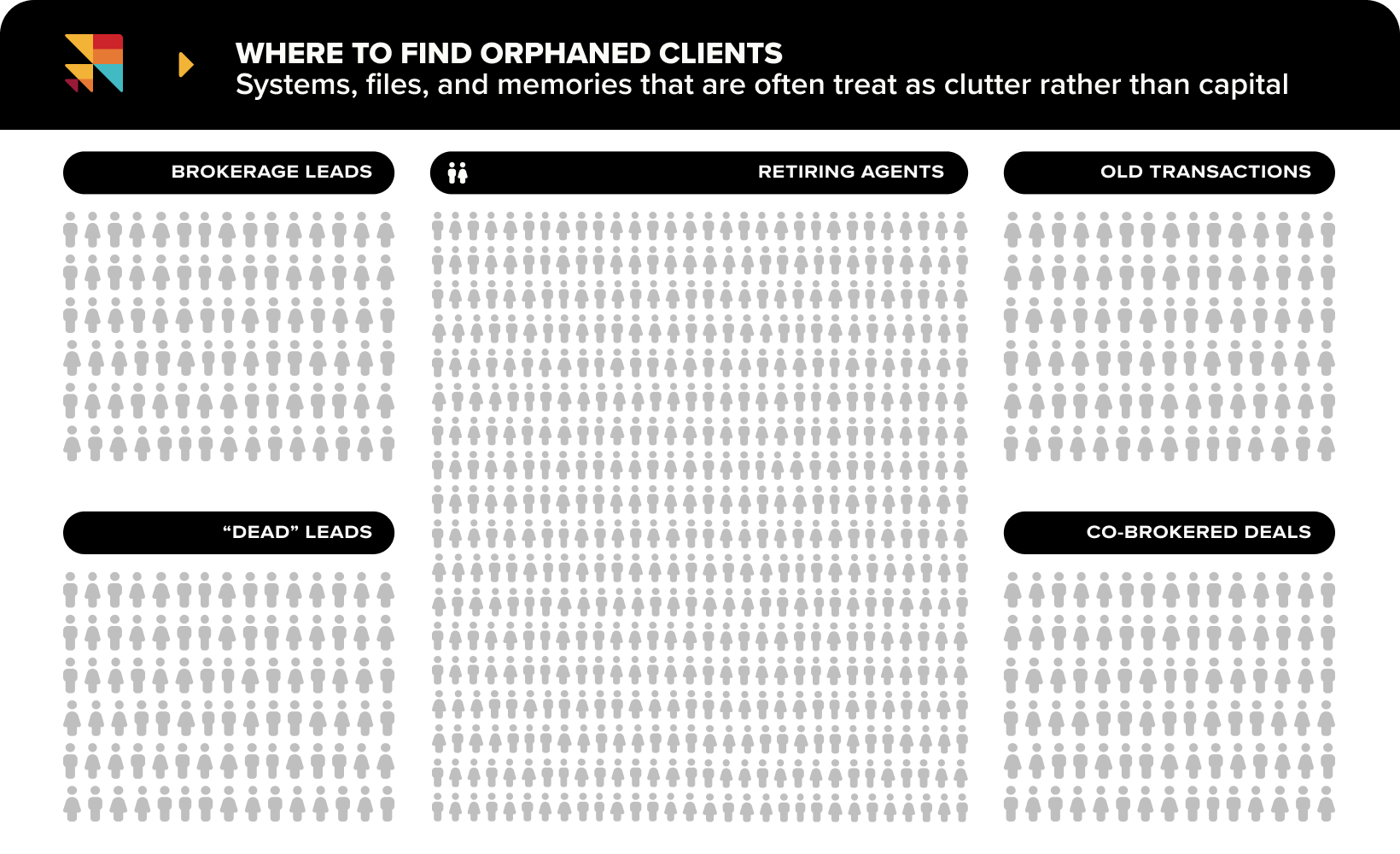
Here are the most common places they live:
- Retiring or semi-retired agents
Agents winding down their business often hold databases full of loyal past clients. These are relationships earned over decades that can and should be transitioned with care. Without a structured handoff, they vanish the moment the license does. - Old transaction records
Compliance systems, accounting files, and back-office software are loaded with transaction histories. Every closed deal represents a family that once chose the brokerage. But without an agent staying in touch, brokerages ignore and lose contact with them. As a result, valuable relationships sit unused in old files. - Co-broke relationships
Every transaction involves two sides. Many brokerages ignore the fact that thousands of potential clients have already experienced their professionalism as the “other agent” in a transaction. With the right outreach and positioning, these co-broke contacts can be nurtured into future clients—especially if their own agent has gone dormant. - “Dead” leads that aren’t really dead
Internet inquiries, relocation leads, and open house sign-ins get classified as cold or unresponsive. But life changes. The renter who ghosted five years ago might be ready to buy today. Without systems to revisit and requalify, these leads slip quietly into someone else’s pipeline. - Company-sponsored leads
Leads paid for by the brokerage through relocation networks, builder partnerships, or paid advertising should never walk out the door with a departing agent. These are company assets, and brokerages must have policies in place to retain them.
The truth is, most brokerages have thousands of names and households already connected to their brand. The problem isn’t scarcity. It’s neglect.
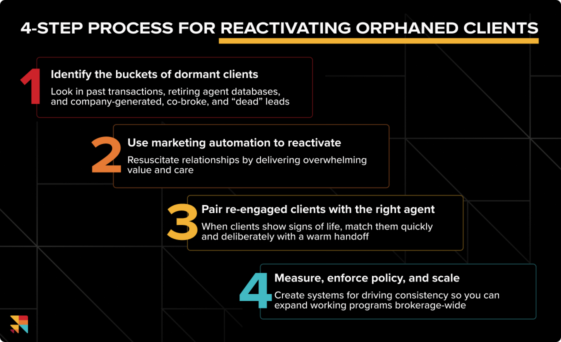
Tactical playbook: A four-step process for reactivating orphaned clients
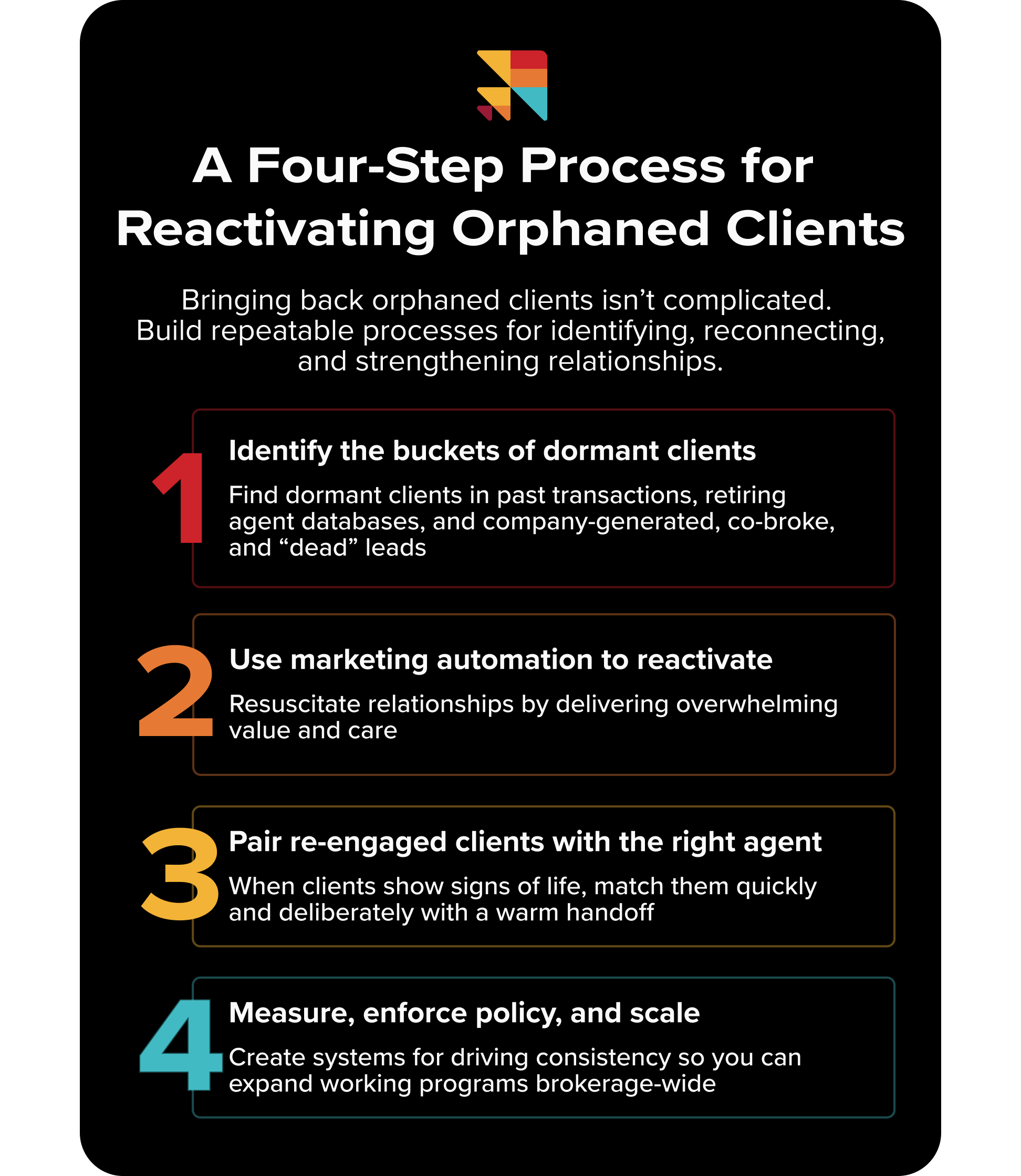
Bringing back orphaned clients isn’t complicated. The brokerages that win don’t treat it as a one-off project, but instead build repeatable processes for reconnecting and strengthening those relationships from the beginning.
Step 1: Identify the buckets of dormant clients
Most brokerages already have thousands of past relationships sitting in plain sight. The first step is running a system-wide audit to surface them.
- Past transactions: Export records from compliance, accounting, and back-office platforms. Every closed file represents a household that once trusted your brand.
- Retiring or disengaging agents: Develop a formal program that enables these agents to transition their databases in exchange for referral fees on future business. This protects their legacy and keeps clients from being abandoned.
- Company-generated leads: Establish clear policies that ensure brokerage-paid opportunities (such as relocation, builder partnerships, and advertising) remain company assets if an agent departs.
- Co-broke and “dead” leads: Mine records of co-broke transactions and “no response” internet inquiries for clients without an active relationship.
Step 2: Use marketing automation to reactivate
Once you know who’s in your orphaned client buckets, the next step is to bring them back to life. Resuscitate relationships by delivering overwhelming value and care.
- Import and clean the data inside a unified CRM.
- Segment contacts (past buyers, past sellers, co-brokes, old leads) to deliver tailored messaging.
- Launch value-driven campaigns with local insights, market updates, and community news. Listings should be shared sparingly and only when specific to their segment’s preferences.
- Track engagement signals to identify who’s opening, clicking, or responding.
Step 3: Connect clients showing signs of life with the right agent
Automation sparks interest, but relationships are human. When a dormant contact re-engages, the brokerage must act quickly and deliberately.
- Develop a matching process that considers geography, specialty, production, and style.
- Introduce the new relationship through a warm handoff, ideally with a note from the brokerage leader or the retiring agent.
- Monitor the first 90 days to ensure the client feels supported and the agent is delivering.
Step 4: Close the loop with policy and measurement
For this process to scale, consistency is required.
- Document referral structures for retiring agents to ensure everyone is compensated fairly.
- Define policies for what happens to company-generated leads when agents switch to a different firm.
- Track conversion metrics on reactivated clients to prove ROI and refine the process.
- Share success stories internally. Every reactivated client is a form of lead generation and reinforces the brokerage’s value proposition without the eye-popping fees associated with external sources.
The technology backbone required
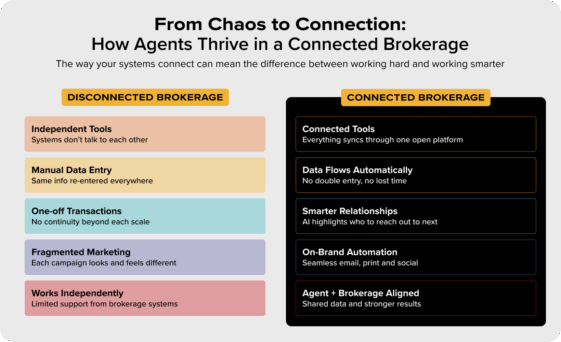
Bringing back orphaned clients is only sustainable when supported by the right systems. A patchwork of spreadsheets, disconnected CRMs, and siloed back-office platforms won’t cut it.
To make this work, brokerages need a tech stack that:
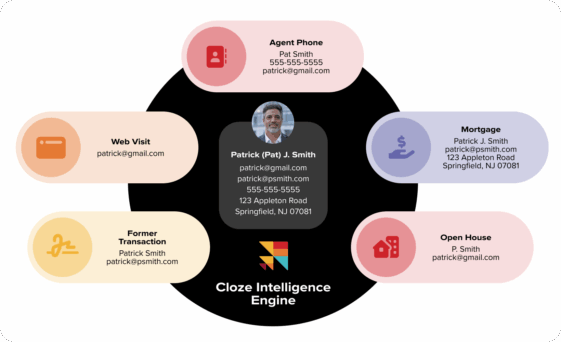
- Centralizes client data — so past transactions, retiring agent databases, and company-generated leads can be unified and easily accessed.
- Automates engagement — with marketing tools that keep dormant contacts warm until they’re ready to reconnect.
- Supports controlled access — ensuring the right agents have the right level of visibility while protecting sensitive data.
- Tracks outcomes — so leadership can measure reactivation efforts, ensure fair referral payouts, and continuously refine the program.
This is where the idea of the Connected Brokerage comes into play.
When CRM, marketing, and transaction systems work together, brokerages can safeguard client relationships, honor agent legacies, and unlock the value that has been dormant in their own records.
Relationship co-ownership in action
The idea of bringing back orphaned clients may seem daunting, but it doesn’t have to start that way.
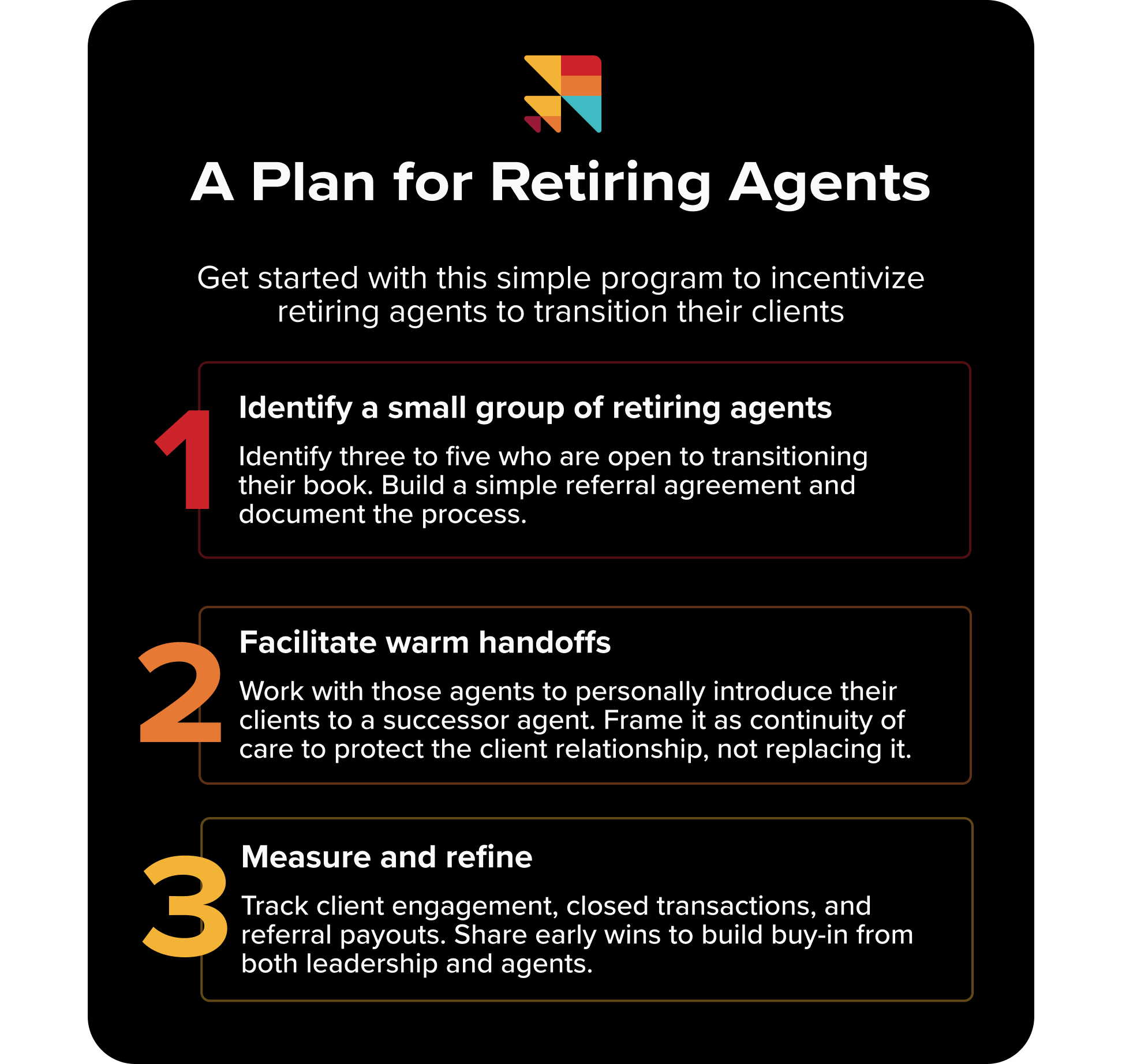 Brokerages can pilot the program in three simple steps:
- Start with a small group of retiring or disengaging agents.
Identify three to five who are open to transitioning their book. Build a simple referral agreement and document the process. - Facilitate warm handoffs.
Work with those agents to personally introduce their clients to a successor agent. Frame it as continuity of care to protect the client relationship, not replacing it. - Measure and refine.
Track client engagement, closed transactions, and referral payouts. Share early wins to build buy-in from both leadership and agents.
Once this foundation is in place, the next step is to expand beyond retiring agents. Brokerages can begin mining dormant files already under their control. Look to compliance archives, co-broke records, and “dead” leads to launch a structured reactivation campaign to revive those relationships.
Each successful reactivation not only generates new business but also protects brand equity, strengthens recruiting, and reinforces retention.
The brokerages that master this discipline will flip attrition on its head. They’ll transform the risk of lost relationships into one of the most powerful growth levers of the next decade.
In our next blog post, we’ll explore the concept of “client co-ownership” further and discuss how it can bolster brokerage profitability.