


Picture two brokerages competing in the same market. Both have strong agents and similar technology budgets, but when the market shifts, one moves quickly and the other is forced to wait. The brokerage that moves quickly can spot a recruiting opportunity in a competitor’s struggling office before anyone else notices. It sees a neighborhood where its market share is low and turnover is climbing, and it redirects marketing spend to capture the opportunity. The other brokerage struggles to adapt while it waits for a vendor update, a report someone has to build manually, and data locked inside systems that were never designed to talk to each other.
The difference between the two isn’t technology: It’s that one brokerage owns its data and the other doesn’t.
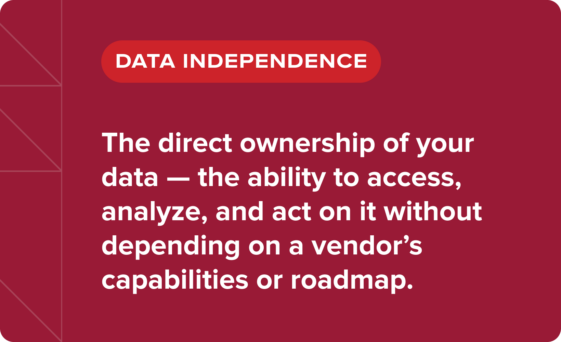
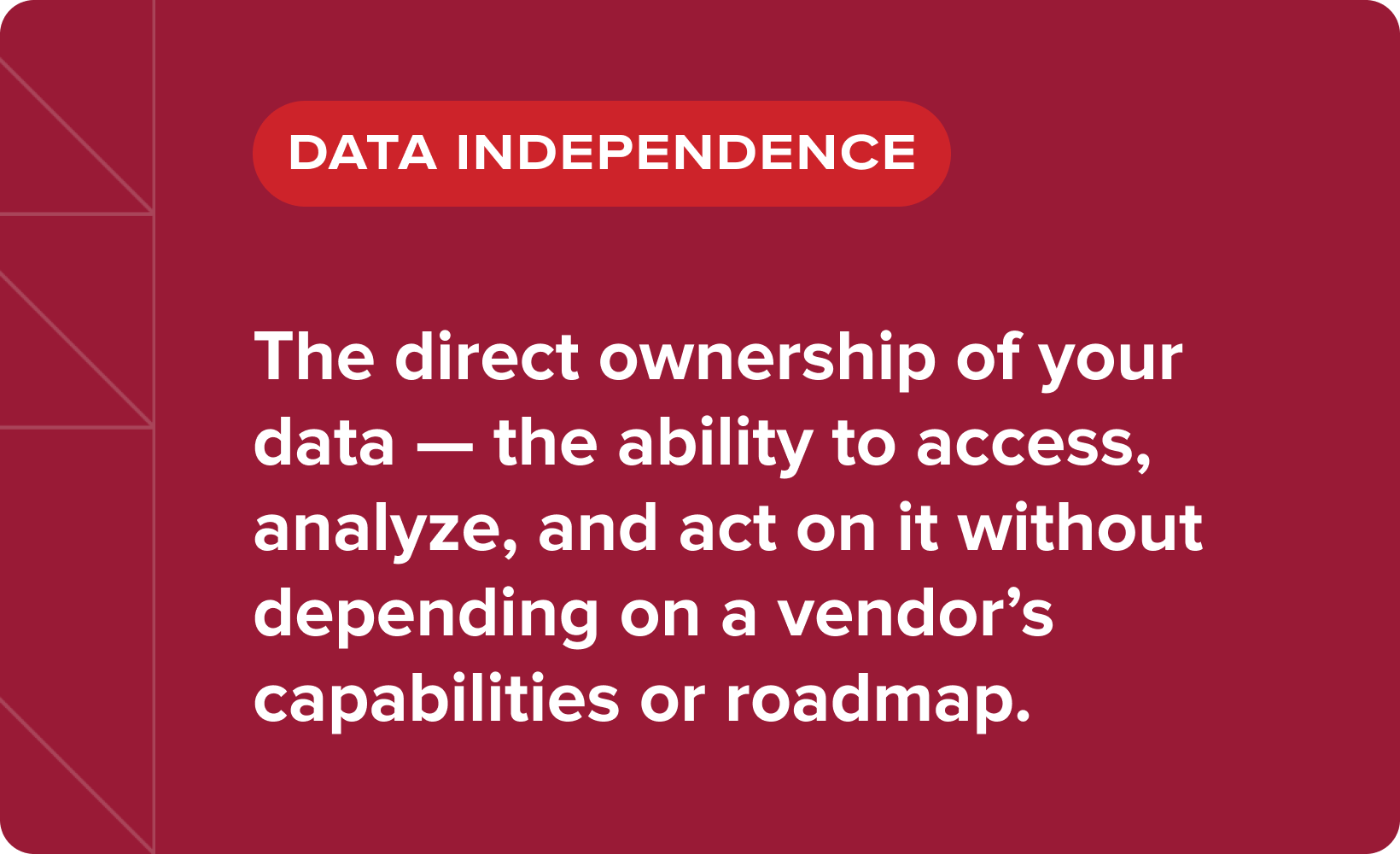
When we talk about data independence, we’re referring to the direct ownership of your data. That idea of owning your data independent of the vendors who typically hold and house that data is the foundation of what we call “The Connected Brokerage,” and it forms the foundation of every competitive advantage covered in this article.
What we mean by data independence
Instead of brokerage data being locked within proprietary tools that require the right functionality to access, a brokerage that achieves data independence can control its own information throughout the business and access, analyze, and act on it without relying on a vendor’s roadmap to catch up.
It’s not a technology feature to check off. It’s a business posture that ensures leadership can determine the agility of the business without restriction from outside forces.
Who sets your strategic agenda? Does your next competitive move depend on what your vendor decides to prioritize this quarter? Or does it depend on your unique competitive advantages?
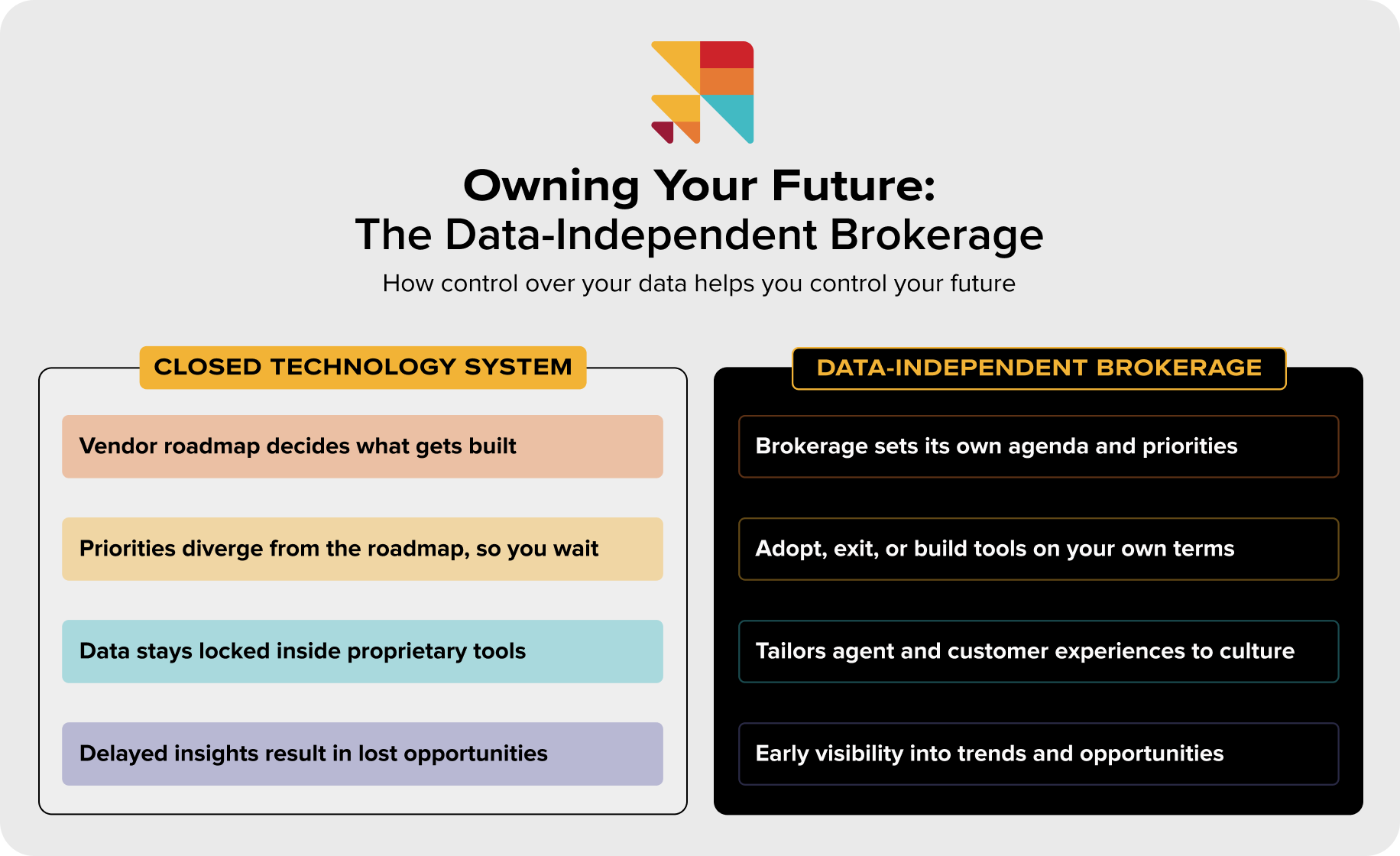
In a closed technology ecosystem, the vendor sets the agenda: They decide which features get built and when. When your priorities and their roadmap diverge, you wait. A data-independent brokerage does not wait. It adopts better tools when they become available, exits vendor relationships when they no longer deliver value, and even develops its own data-based experiences if what it wants doesn’t exist.
Not all of your data carries equal weight. The two most valuable categories are your relationship history and your operational signals. Your relationship history goes far beyond a contact list. It is the record of who your agents talk to and what those conversations have produced over time. It signals the strength of the engagement between the brokerage, the agent, and the client, and it cannot be rebuilt once it is lost. Your operational signals are the leading indicators that tell you what is about to happen before the numbers confirm it. When you own both, you can see around corners. When you do not, you are always responding to what has already happened.
The strategic advantage does not come from the technology. It comes from understanding your market, your marketing, and the freedom to act with conviction when the opportunity presents itself.
The window of opportunity
Readers of our Connected Brokerage series will recognize the pattern. In that earlier work, we highlighted how Rocket’s acquisition of Redfin was explicitly framed around 14 petabytes of combined data and a stated goal of building an integrated end-to-end ecosystem. The strategy was clear: use data at scale to move upstream of individual brokerages. Proximity to the customer relationship is the brokerage’s final stand.
In January 2026, the same logic drove Compass’s acquisition of Anywhere Real Estate, bringing Anywhere’s portfolio of household-name brands under a single parent company with a stated goal of moving approximately 340,000 agents onto a shared technology platform. The consolidation is real, and it is accelerating.
But history offers an important counterpoint.
Centralized decision-making across vastly different markets and consumer profiles reliably produces the same outcome: Everyone and every place gets treated the same. What works in suburban Scottsdale gets standardized for downtown Boston. The result is a platform optimized for no particular market, with operators struggling to adapt to local conditions because the strategic agenda is being set for the middle of a bell curve.
That creates a real window for independent brokerages willing to act now. While much of the industry watches and waits to see how the consolidation unfolds, the market is not waiting. Homebuyers and sellers are actively transacting and choosing who to work with. Research shows that consumer willingness to pay a premium for high-quality experiences grew from 65 percent to 69 percent between 2024 and 2025, and that nearly three-quarters of consumers actively seek out authentic local experiences over standardized ones. A brokerage that moves on its own data and delivers an authentic local experience is not competing on the same terms as a 340,000-agent generic platform. It is competing on entirely different ground. Right now, that ground is open.
 What becomes possible
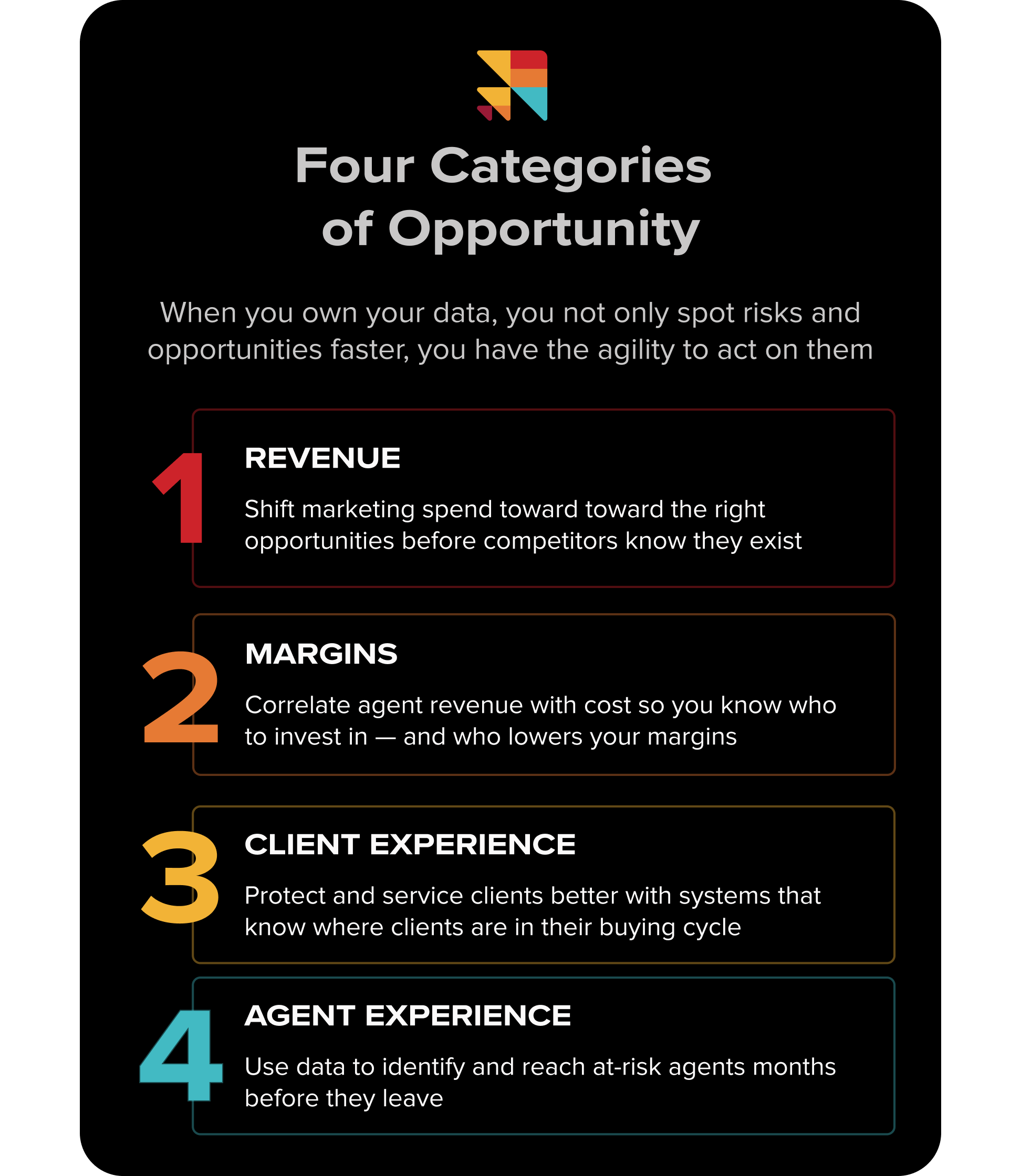
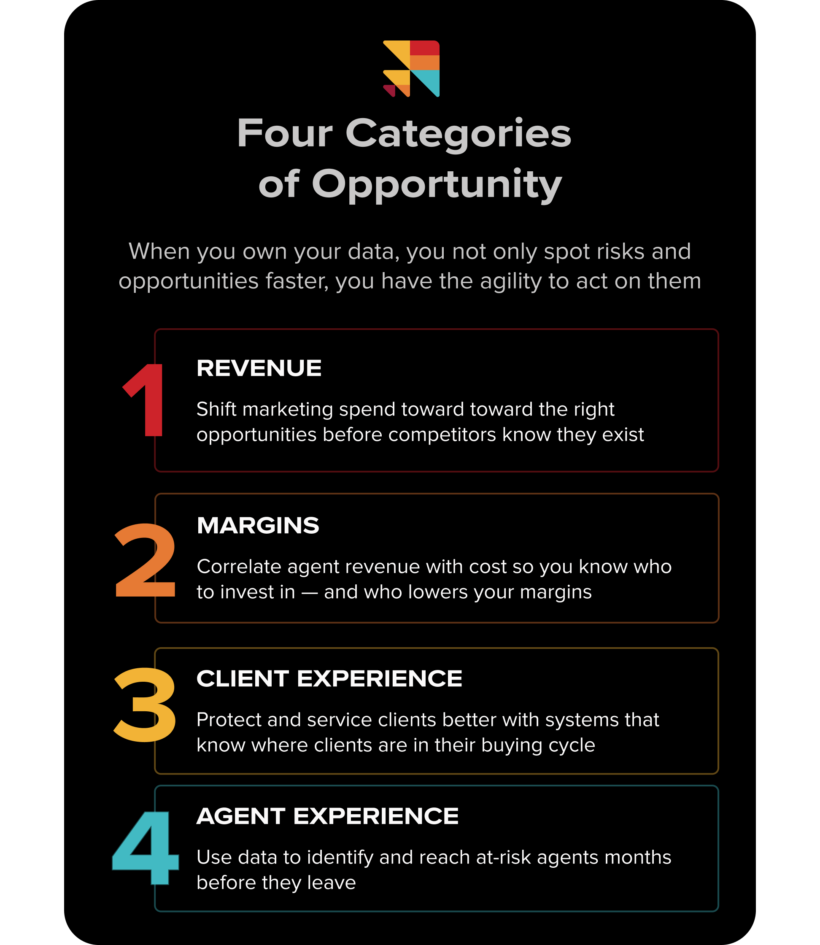
When a brokerage owns its data, four categories of opportunity open up.
Revenue. Your MLS data shows which neighborhoods are turning over. Your lead generation data shows where your conversion rates are strong. When those two sources work together, you shift marketing spend toward the right opportunities before competitors know they exist. Instead of following the market, you get ahead of it.
Margins. Your back office tracks which agents generate the most revenue. Your accounting system tracks the cost of supporting each of them. When those systems inform each other, you make precise decisions about who to invest in and where to pull back. A brokerage that knows which segments of its agent population drive the most retained earnings can protect margin in ways a disconnected operation simply cannot.
Client experience. When a transaction goes pending, your client faces peak exposure to wire fraud. A data-independent brokerage connects its transaction management system to its client communications and automatically delivers a security protocol at exactly that moment, for every transaction. That is a brand promise backed by operations, not marketing.
Agent experience. Production declines rarely happen overnight. They show up first in the data: fewer logins and a slowdown in scheduled activity before the numbers confirm it. A brokerage that owns those signals can reach out to an at-risk agent months before the agent begins considering other options. Proactive retention is only possible when you can see what is happening in time to act.
In each case, the outcome is not due to better software. It is the result of a brokerage that controls its own information.
The decision in front of you
Every brokerage generates a wealth of data through its agents and daily operations.
The question is not whether that data exists. The question is who controls it.
A data-independent brokerage controls it. That control lets you choose your partners and compete on a strategy no vendor can redirect. It is also what determines your business’s long-term value. A brokerage built on owned data and engineered outcomes is a fundamentally stronger asset than one built on rented access to someone else’s system.
If this sounds like another technology pitch, consider what separates this conversation from prior ones. The brokerages already operating this way are not the ones that bought the most software. They are the ones who decided what outcomes they needed and built their operations around producing them. The technology followed the strategy.
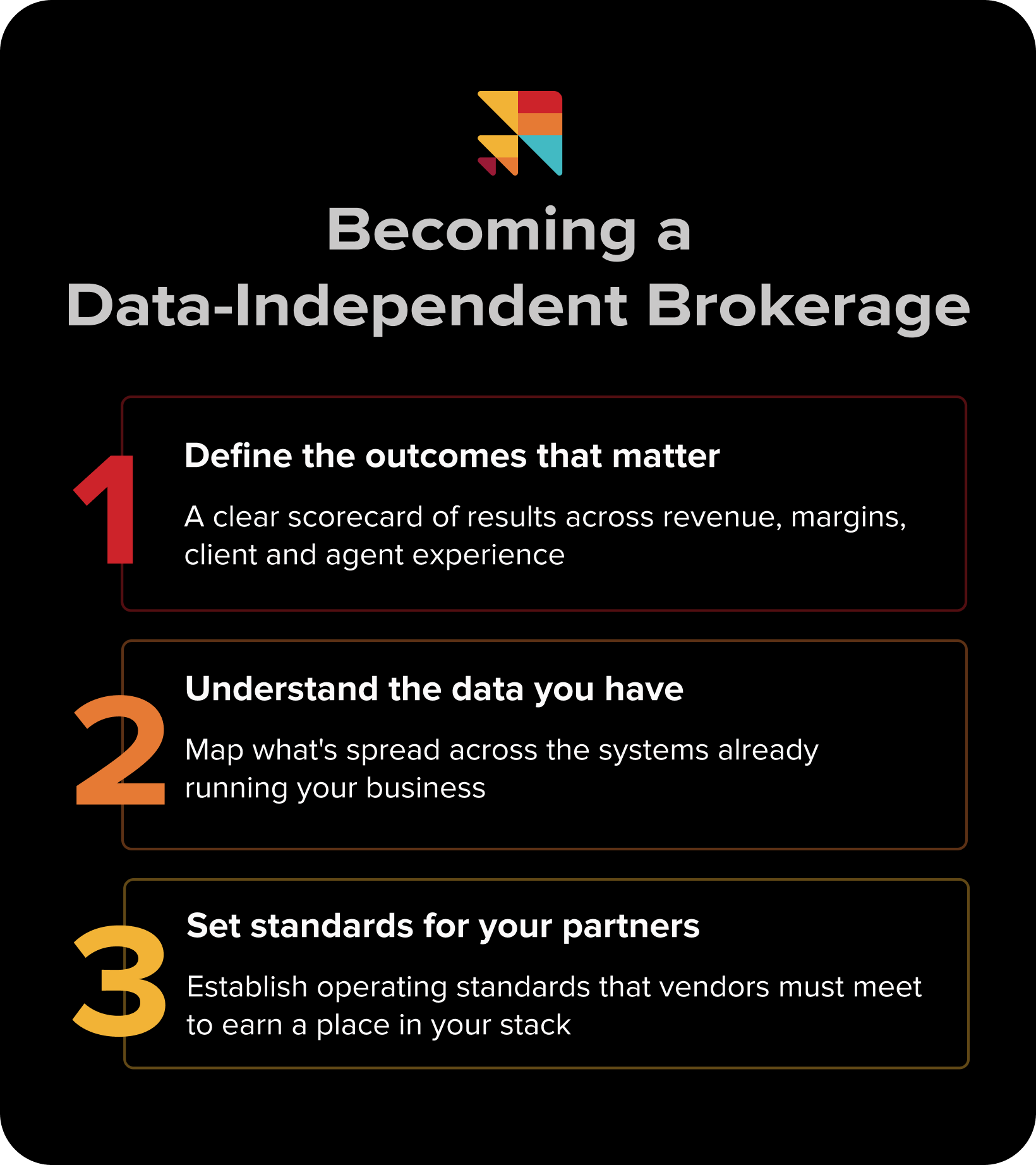
If this business posture sounds like the kind of brokerage you want to build, the next question is where to start. There are three areas where the work of becoming a data-independent brokerage actually happens:
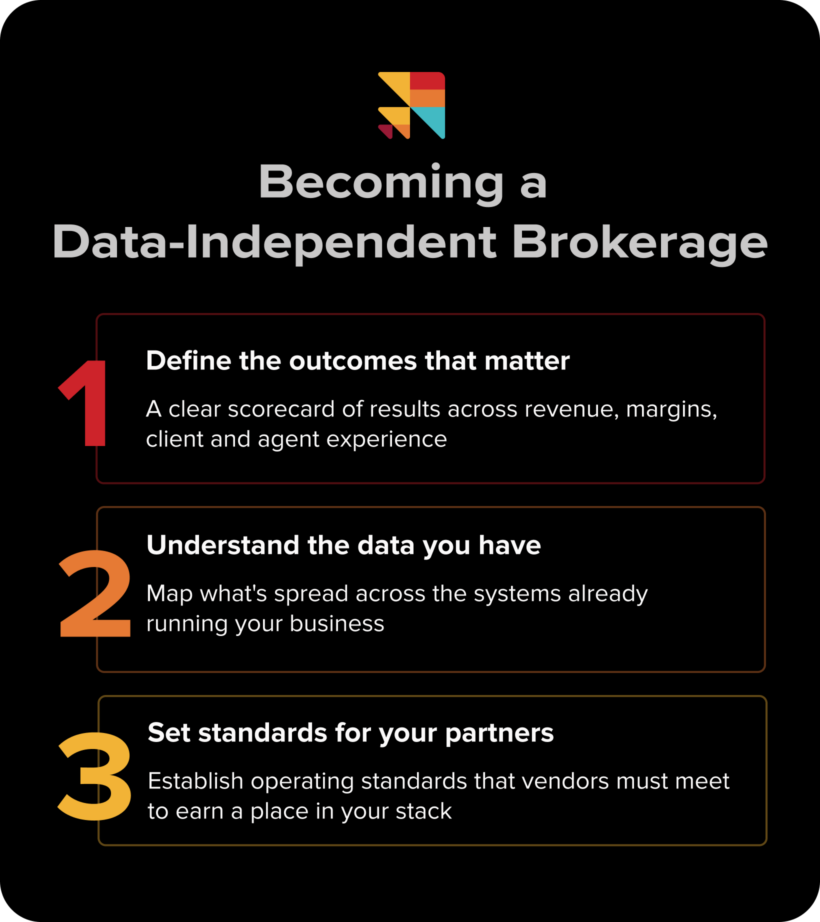 Defining the outcomes that matter. Before you evaluate any technology, you need a clear scorecard of the business results you intend to produce across revenue, margins, client experience, and agent experience. This is the work that separates strategic investment from defensive spending.
- Understanding the data you already have. Most brokerages are sitting on far more useful information than they realize, spread across the systems that already run their business. Mapping what you have and what it can produce is the foundation of every move that follows.
- Setting the standards your partners must meet. Once you know what outcomes you want and what data supports them, you can establish the operating standards any vendor must meet to earn a place in your stack. This is how you protect the independence you have built and avoid quietly giving it back over time.
The brokerages that act now, while the industry’s largest players are consumed by their own integration challenges, will be the hardest to displace when the dust settles. The work is not as disruptive as you might fear. Our Connected Brokerage series is a great place to start to explore the outcomes and the data, and our recent articles on orphaned clients and shadow contacts offer concrete ways data ownership can impact your business.
In upcoming articles, we’ll continue to explore these concepts and how to begin to reclaim your data independence.