


Over the years, brokerages have turned client relationships over to agents. In this article, we discuss the roots of that shift, its impact on profitability and production, and the benefits of shifting that model to one where both agent and brokerage share responsibility for maintaining client relationships over time. We call this relationship co-ownership.
How brokerages lost touch with clients
For decades, brokerages stepped back from client relationships. Higher commission splits, the rise of agent brands, and the need for efficiency meant agents took on more responsibility for marketing, client management, and follow-up. As brokerages ceded control, it became increasingly difficult to justify their role in the value chain.
Early on, brokerages tried to justify their value with brick-and-mortar locations and later through technology and lead generation. Instead of strengthening the partnership, low adoption, and fragmentation, and poor quality pushed them further back to the point that sometimes their name barely appeared on the door. In this agent-centric world, agents naturally claimed exclusive ownership of their relationships. The agent-owned relationship became the industry standard.
However, leaving relationship ownership solely to the agent has left brokerages with little control over retention or repeat business.
Brokerages are forced to rely on agents to maintain the relationship, consistently follow up, and drive core services. This has created even greater dependence on “great” agents, without strong avenues to support average agents to become better. Worse, when agents leave, so do relationships and future deals.
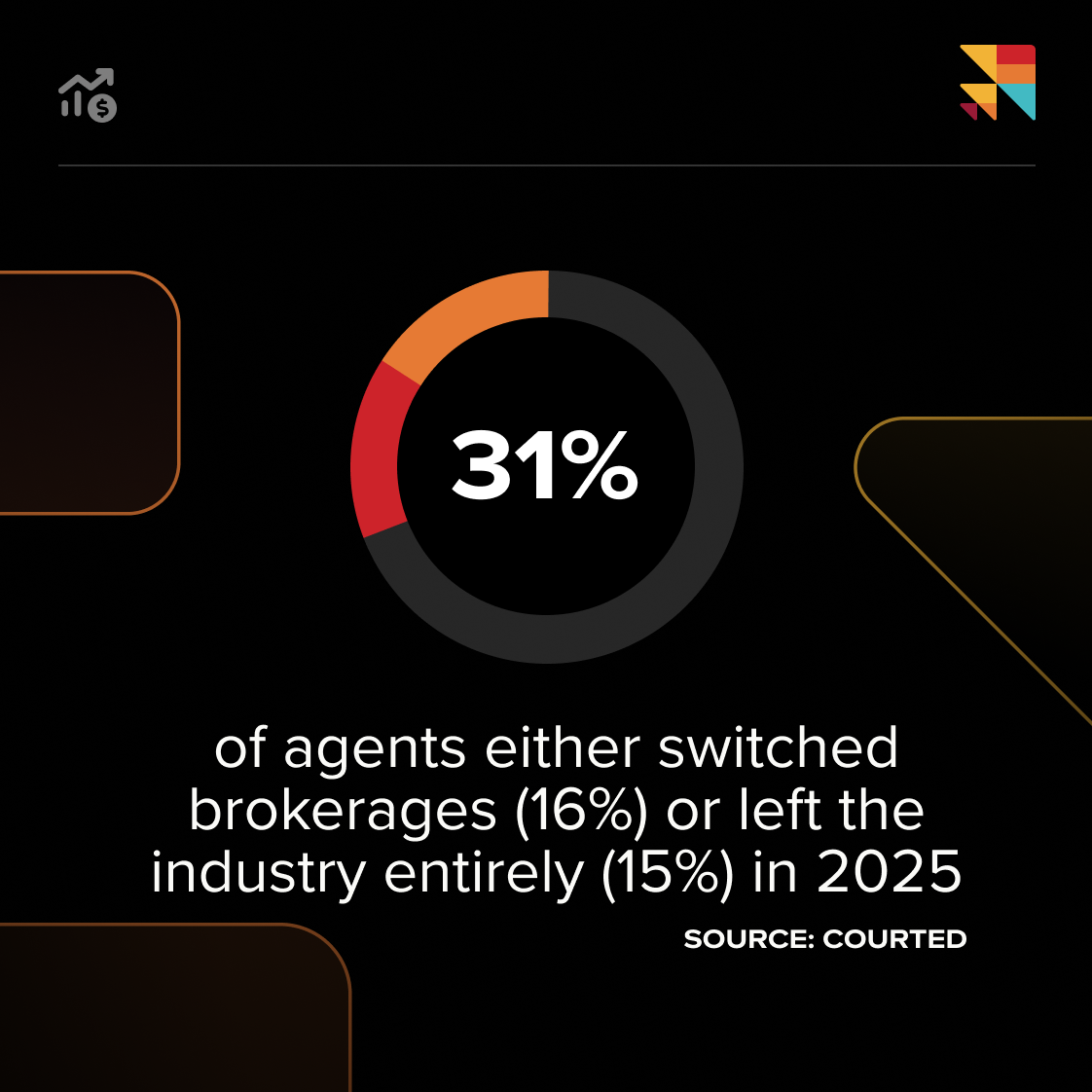 This isn’t hypothetical. According to NAR, 87% of agents leave the industry within five years. Meanwhile, Courted reports between 16-18% of agents switch brokerages every year—a number that has stayed steady since 2020 and represents $590 billion of the year’s total sales volume.
Without a shared system between agent and brokerage, the clients can and will drift away—often into the hands of portals like Zillow and Redfin that have built sophisticated systems to stay in touch.
The brokerage model has stayed this course since the 1980s, sometimes willingly, sometimes by default.
How we got here
It began with splits. High-split and 100% models resulted in agents taking over branding, marketing, and client care in exchange for fewer services from the brokerage. Then came attempts to deliver technology, but tools were fragmented and disconnected. Lead gen here, back office there, marketing tools somewhere in between. Nothing worked together. No unified CRM, no integrated strategy, no consistent way to nurture clients after the close.
Into that vacuum stepped Zillow, Redfin, Realtor.com, and now Homes.com. They didn’t just fill the gaps.
Portals built sophisticated systems to maintain relationships long after the transaction. They systematically moved to own them, re-engaging clients months or years after closing with personalized alerts, financing offers, and automated touches all in the name of referring business to agents, albeit with a hefty referral fee. Agents were no match for these industry juggernauts and, over time, have been moved to the sidelines.
Today, many consumers hear from these platforms long before they hear from their agent or brokerage.
This wasn’t just a missed opportunity. It was a strategic mistake that’s costing brokerages repeat business, referrals, and relevance.
The good news: it’s not too late to change course.
A better model: Relationship co-ownership
The solution isn’t choosing between the agent and the brokerage. It’s recognizing that both have a role to play in maintaining client relationships over time.
Relationship co-ownership is a model where agents and brokerages share responsibility for client relationships.
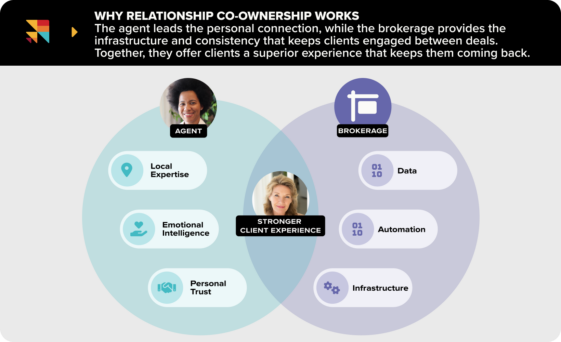
The agent leads the personal connection, delivers the expertise, and manages the transaction. The brokerage provides the infrastructure, automation, and consistency that keeps clients engaged between deals.
This isn’t about replacing agents or undermining their relationships. It’s about protecting those relationships together—especially during the critical moments when agents transition, retire, or simply get overwhelmed by active business.
Here’s why it works: agents and brokerages excel at different things. Agents bring local expertise, emotional intelligence, and personal trust. Brokerages bring systems, data, and the ability to deliver consistent value at scale. Together, they create a stronger client experience than either could deliver alone.
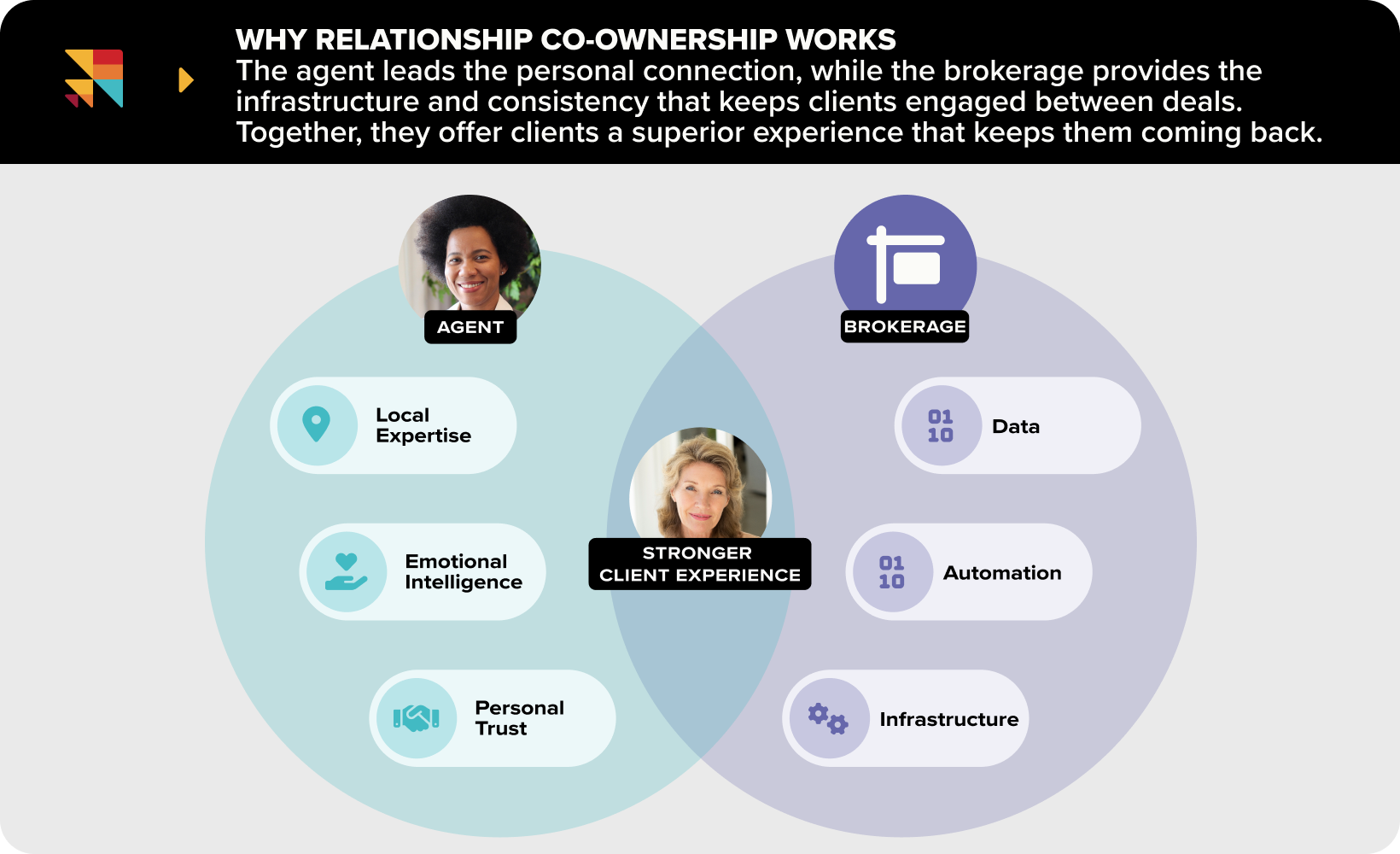
Why relationship co-ownership works: The agent leads the personal connection while the brokerage provides the infrastructure and consistency that keeps clients engaged between deals. Together, they offer clients a superior experience that keeps them coming back.
Building trust through shared responsibility
The relationship between agent and client is personal. That trust is earned through years of effort, connection, and service. That trust is earned by the agent and respected by the brokerage. When structured properly, that trust extends to the brokerage as well—not as a replacement, but as a support system that reinforces the agent’s work.
After a transaction occurs, the relationship evolves.
Leading brokerages formalize this through clear agreements that define who contacts the client, when, and under what circumstances. These rules of engagement create transparency, maintain agent privacy, and prevent confusion when agents transition or retire. They ensure clients never feel abandoned, even if their original agent leaves the industry.
This structure works because agents and brokerages excel at different things. Agents lead the relationship; brokerages support it with structure, data, and consistency. Together, they preserve connections through any transition.
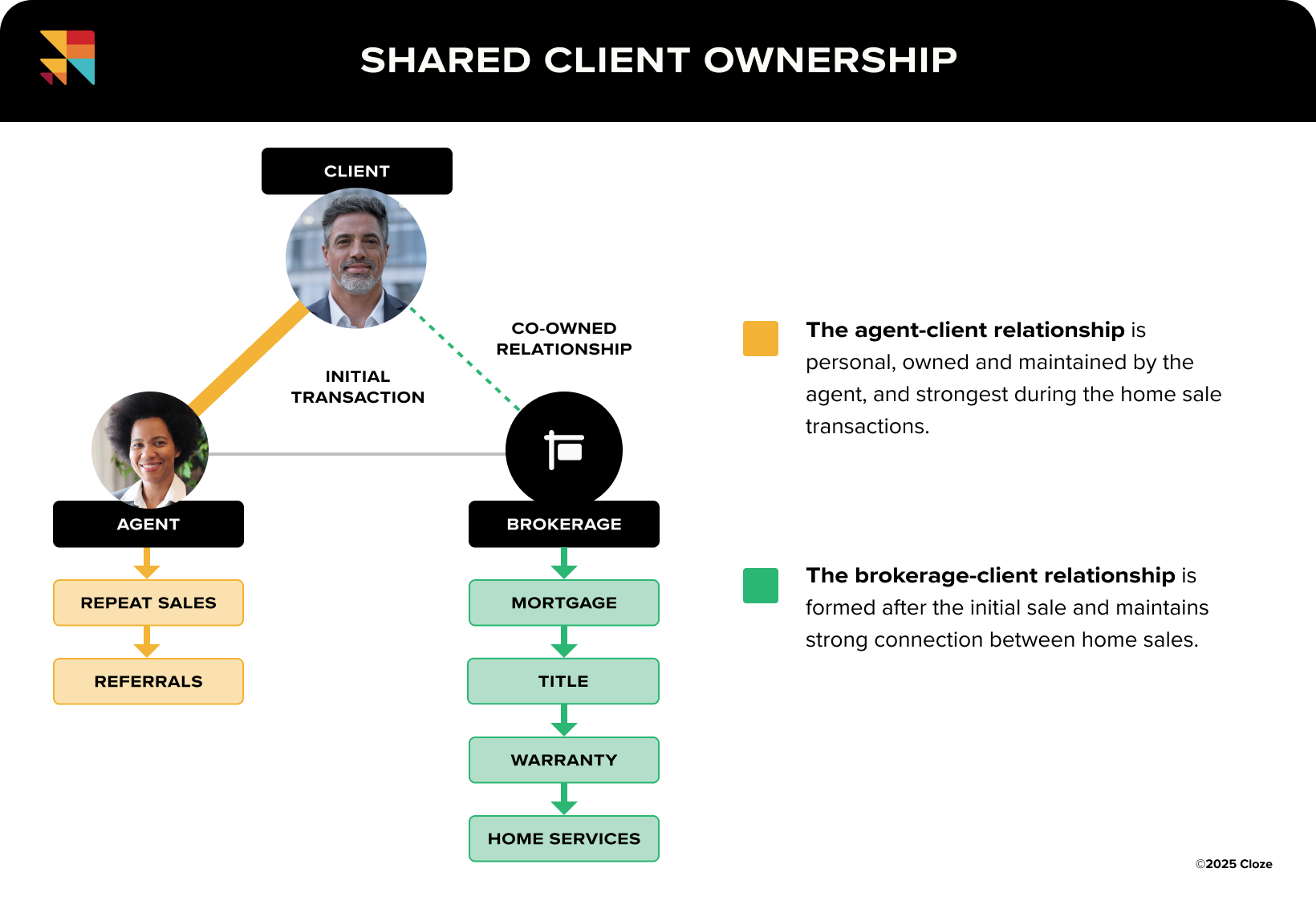
Agents are better at the human side of the relationship. They’re on the ground, in the home, face to face with the client. They know the context. They hear the emotion behind the decision. They remember the little things.
Brokerages are better equipped to deliver consistent value at scale. They have the systems to nurture relationships across time. They can provide data, automation, and visibility that most agents simply don’t have time to manage on their own. Clients benefit from consistent communication and continuity of service, regardless of what happens with individual agents.
When both sides commit to this model, the results are measurable: higher repeat business, stronger referral rates, better ancillary service capture, and deeper agent loyalty.
Five ways agents benefit from relationship co-ownership
In a relationship co-ownership model, success depends on each side contributing where they’re strongest. Agents bring trust, expertise, and emotional intelligence. Brokerages bring infrastructure, automation, and long-term consistency.
Here are five specific ways brokerages can fulfill their part of that responsibility.
 1. Supporting post-close nurture
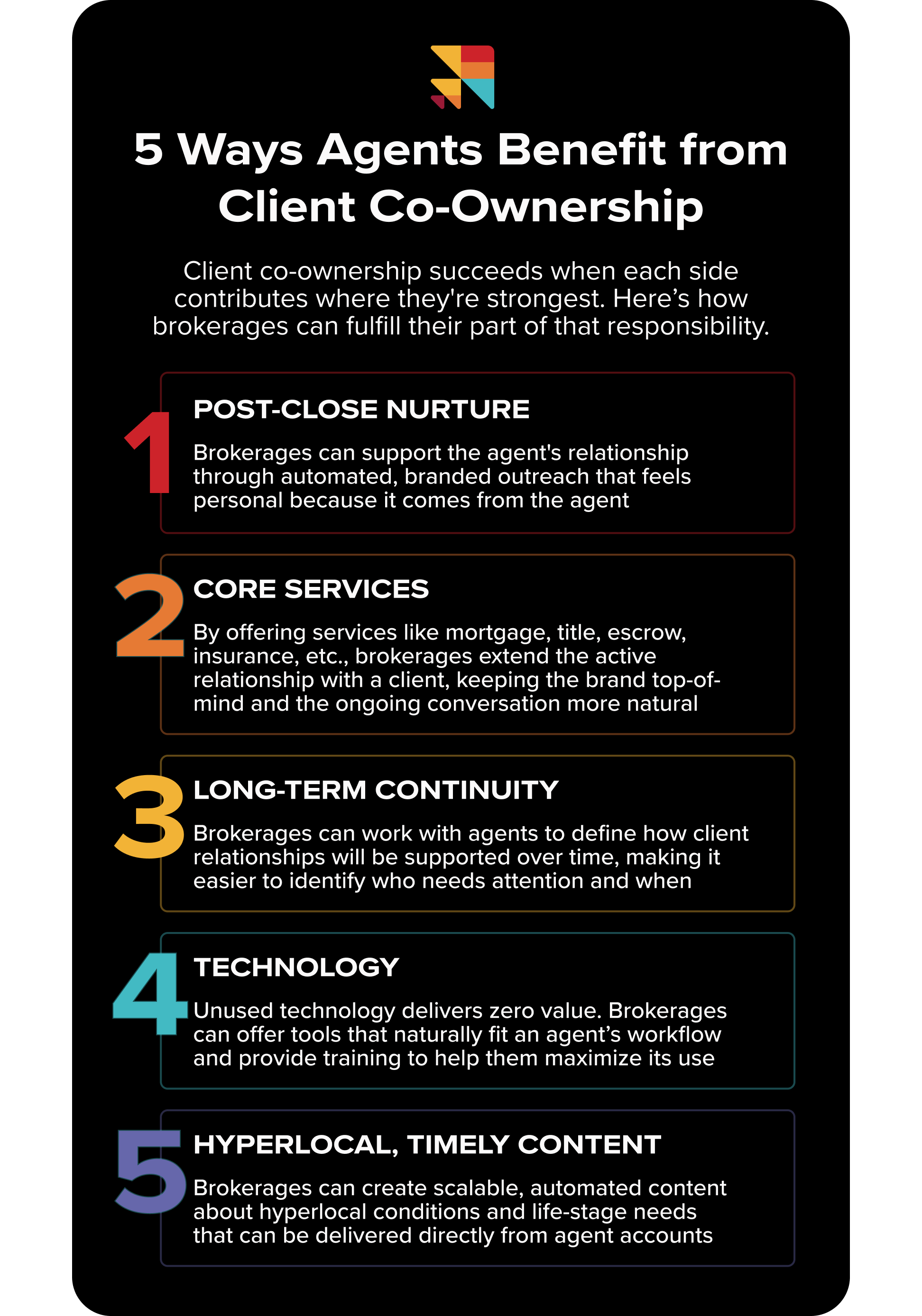
Agents often intend to stay in touch after closing, but active business gets in the way. Brokerages can support the agent’s relationship through automated, branded outreach that feels personal because it comes from the agent.
Think anniversary messages, local market updates, and community event announcements. The content is created and powered by the brokerage, but it’s sent from the agent’s email with room for the agent to add their own personal touch. That’s relationship co-ownership at work: shared execution, shared benefit.
A typical Cloze user can set up a 12-month follow-up plan in minutes. Each message is personalized by the agent and sent from their email address. It’s the perfect combination of brokerage efficiency and agent authenticity.
2. Bringing ancillary services into the conversation
Real estate isn’t a one-product business. The very existence of today’s brokerages depends on clients using multiple services—mortgage, title, insurance, escrow, and home warranty. These services increase lifetime client value, offer better profitability, and strengthen the overall relationship.
Agents are well-positioned to introduce these services, but they often don’t. Either the timing feels awkward during the transaction, or the follow-up never happens afterward. In a relationship co-ownership model, the brokerage provides structure and timing for these conversations, making them feel natural rather than transactional.
When ancillary services are introduced with the client’s needs in mind, the results are significant. Brokerages like Baird & Warner have boosted mortgage capture rates to over 70% by using systematic processes, coordinated timing, and the right technology to support their employee agents.
3. Providing long-term continuity
With relationship co-ownership, continuity is planned rather than improvised. Clear agreements ensure smooth transitions when agents move on or retire, so clients never feel abandoned.
The most effective brokerages make continuity part of their operating model from day one. They work with agents to define how client relationships will be supported over time. They provide tools that make it easy for agents to identify who needs attention and when. And they establish brokerage-led outreach that supports and reinforces agent efforts.
Agents retain ownership and privacy of their client data. Previously agreed-upon rules of engagement create clarity that builds trust on all sides: the agent, the client, and the brokerage.
Cloze helps brokerages maintain continuity by organizing client timelines, tracking interactions, and enabling seamless handoffs when needed. The brokerage stays in the background, steady and supportive, always serving the relationship.
4. Helping agents actually use the technology
There’s no shortage of tools in real estate. But there’s a shortage of adoption, and unused technology delivers zero value.
Agents are more likely to use technology that fits naturally into their workflow and delivers immediate value. Platforms that surface reminders to follow up based on client behavior, life milestones, or time since last contact make agents more personal, prepared, and efficient without requiring them to learn a whole new system.
When adoption is high, brokerages become part of the client relationship rather than standing on the outside looking in. The infrastructure works, agents appreciate the support, and clients benefit from more consistent communication.
5. Delivering hyperlocal, timely content
Most clients don’t care about national market trends. They care about what’s happening in their zip code, their school district, and their neighborhood. They care about timing, context, and relevance.
Agents are excellent at reading their market and responding in the moment. Brokerages can complement this strength by creating scalable, automated content that addresses hyperlocal conditions and life-stage needs without requiring agents to create everything from scratch.
When brokerages use CRM-driven outreach to deliver content tailored to move-up buyers, downsizers, or investor segments, they enable agents to stay relevant and top-of-mind. This isn’t a marketing campaign. It’s relationship reinforcement that keeps the brokerage and the agent visible when it matters most.
Why relationship co-ownership matters now
The traditional agent-only model for client relationships has a fundamental weakness: it’s fragile. It depends entirely on individual agents maintaining contact with every past client, and that rarely happens at scale.
The data tells the story. According to NAR, only one in three clients returns to work with the same agent, even when the first experience was positive. They drift away. Agents lose touch. Clients get reached by someone with better timing or a more consistent presence.
And timing matters more than most brokerages realize. Research shows that 70-80% of buyers and sellers interview only one agent, and they usually choose the one they’ve heard from most recently. Staying top of mind isn’t optional. It’s essential.
But here’s the challenge: the average homeowner knows anywhere between nine and twelve agents. They have a cousin who just got licensed, a neighbor who sells part-time, and a parent from their kid’s soccer team. The competition isn’t just Zillow or Redfin. It’s the quiet familiarity of someone who’s simply been more visible.
When agents lose touch or leave the business—which happens to 87% within five years, according to NAR—the client relationship often dissolves. Without brokerage involvement, there’s no path to reclaim it. The client moves on, and the opportunity is gone.
Meanwhile, the portals are playing the long game.
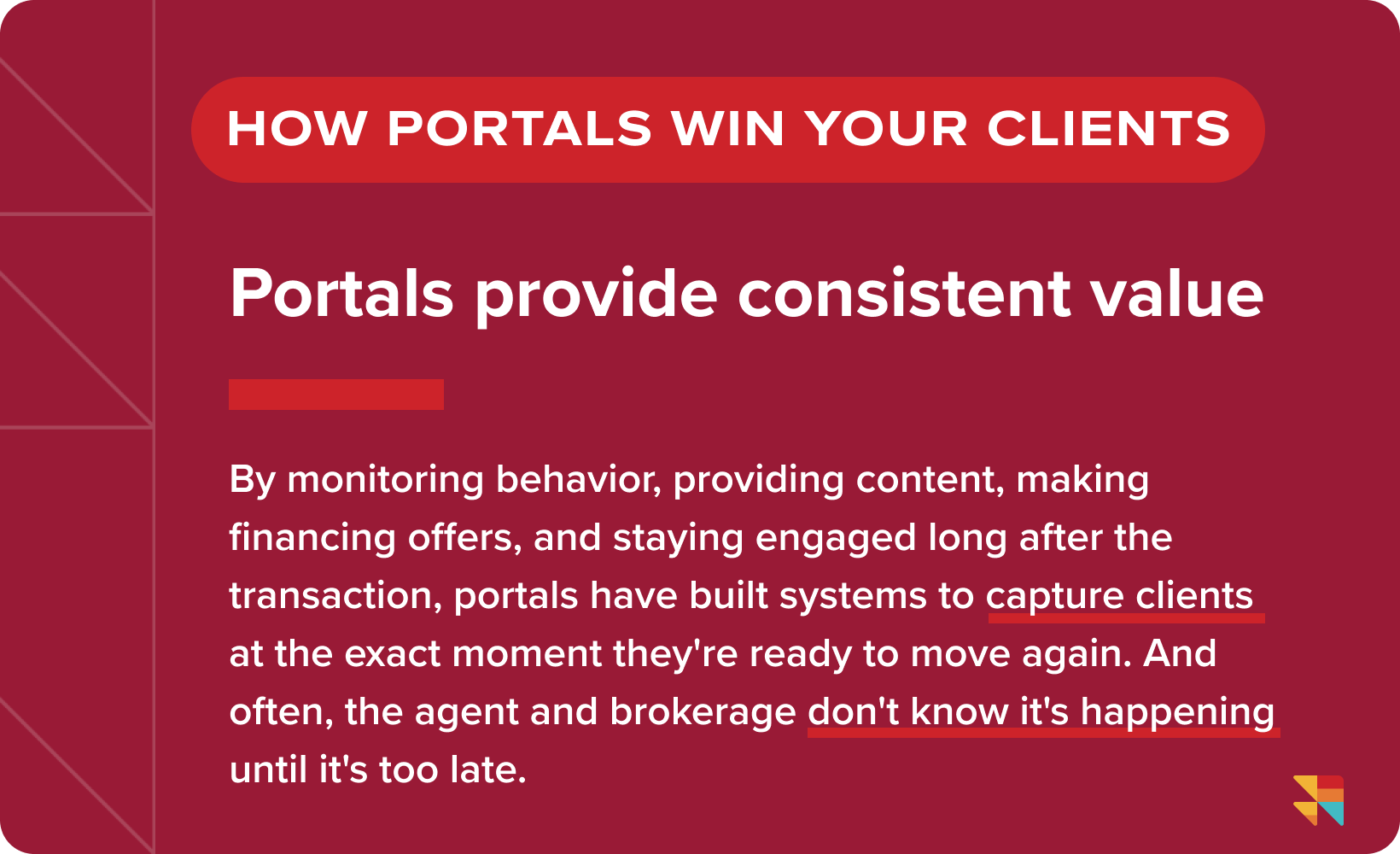
How portals win your clients: Portals provide consistent value: They’re monitoring client behavior, providing relevant content, making financing offers, and staying engaged long after the transaction. They’ve built systems to capture clients at the exact moment they’re ready to move again. And often, the agent and brokerage don’t even know it’s happening until it’s too late.
This is the risk of putting all your relationship equity in one basket.
The case for shared responsibility
Relationship co-ownership isn’t about undermining agents. It’s about providing the infrastructure agents need to stay connected, relevant, and visible with clients over time.
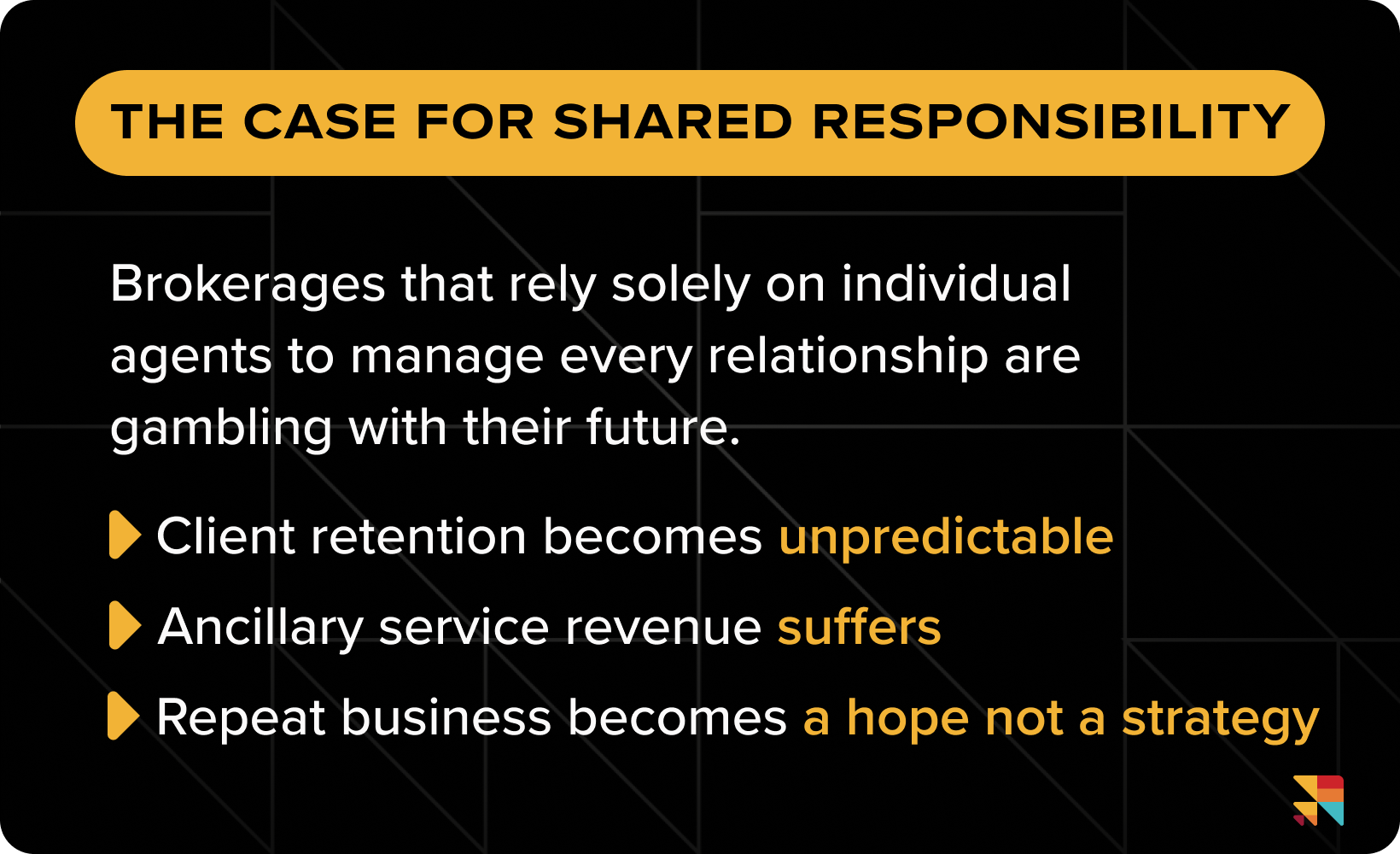
Brokerages that rely solely on individual agents to manage every relationship are gambling with their future. Client retention becomes unpredictable. Ancillary service revenue suffers. Repeat business becomes a hope rather than a strategy.
Brokerages that invest in shared systems, clear agreements, and relationship co-ownership are building something more resilient. They protect client relationships through agent transitions. They create consistent touchpoints that keep both the agent and the brokerage visible. They generate measurable results: higher repeat rates, stronger referral business, and better ancillary service capture.
When the client relationship is shared intentionally, it’s protected collectively. That’s not theory. That’s the business case for relationship co-ownership.
What relationship co-ownership looks like in practice
Here’s how agents and brokerages divide responsibilities in a relationship co-ownership model:
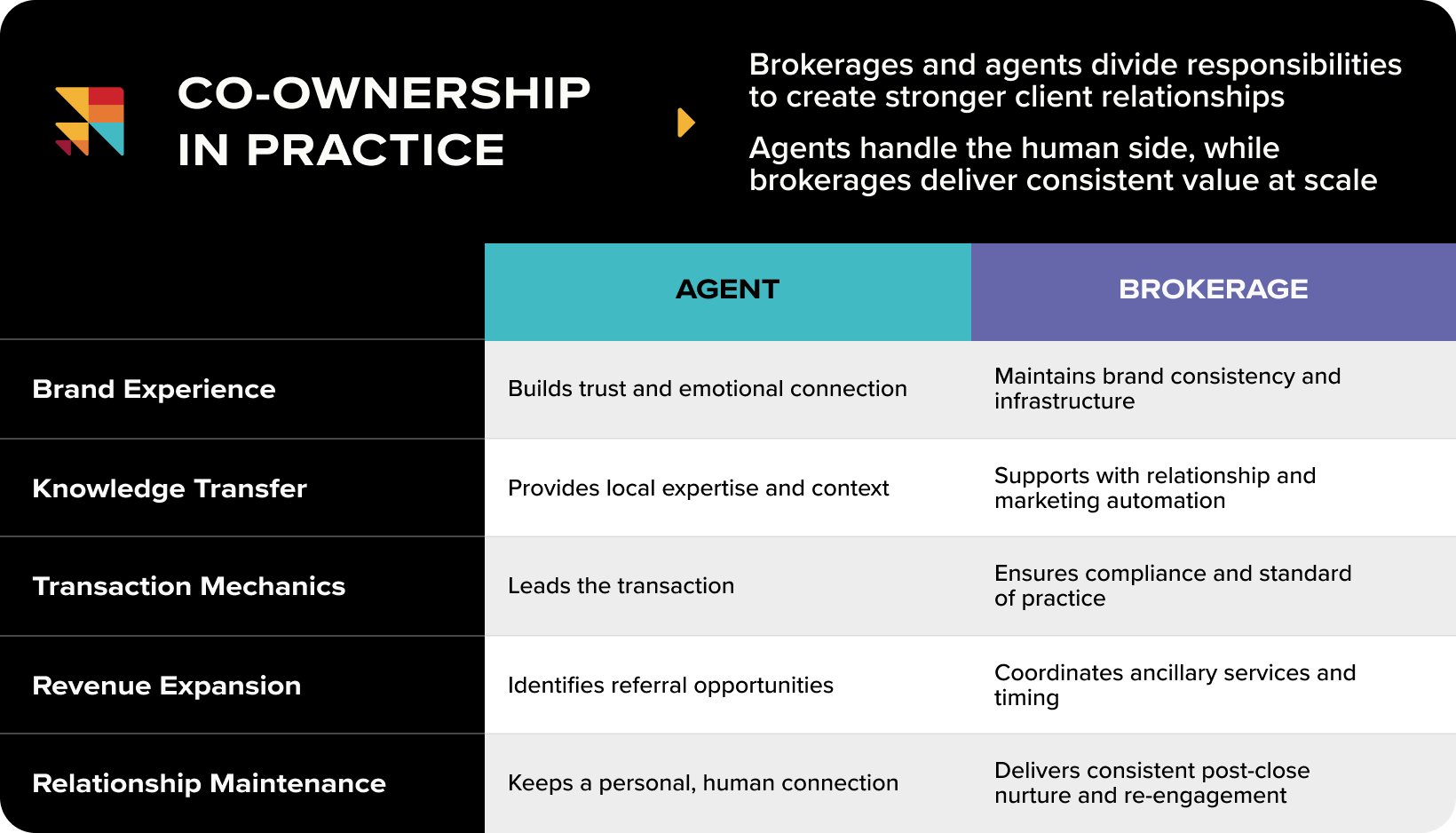
Agents handle the human side of the relationship. They’re on the ground, in the home, face-to-face with the client. They know the context, hear the emotion behind every decision, and remember the details that matter.
Brokerages deliver consistent value at scale. They have the systems to nurture relationships across time and provide the data, automation, and infrastructure that most agents simply don’t have the bandwidth to manage on their own.
Together, they create something stronger than either could build alone.
The path forward
The future of real estate isn’t about control. It’s about continuity.
In a market defined by fewer transactions, tighter margins, and increasing competition from portals, the most valuable asset any brokerage has is the trust built between clients and agents. Relationship co-ownership protects that trust through systematic support, clear agreements, and shared commitment to the client experience.
Brokerages that formalize this model will see measurable results: higher repeat business, stronger referral rates, better ancillary service capture, and deeper loyalty from agents who see the brokerage as a true partner in building their business.
This isn’t a philosophical shift. It’s a strategic one that directly impacts your bottom line.
The brokerages that invest in relationship co-ownership—through connected systems, clear rules of engagement, and genuine partnership with their agents—will be the ones that thrive over the next decade.
They’ll capture more lifetime value from every client.
They’ll retain more agents.
And they’ll build a competitive advantage that portals can’t replicate.
The client relationship is too valuable to leave to chance. It’s time to build a better model together.