





Back in April, a small group of brokerage leaders met for our first Mastermind session to talk about client continuity: how brokerages hold on to client relationships when agents retire, leave, or lose touch. (Six brokerages, one problem covers what we learned.) That conversation raised a bigger question: how do independent brokerages compete with national players that have far more data?
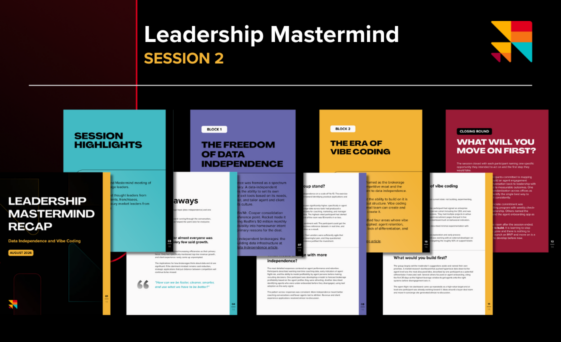
A few weeks ago, brokerage leaders (some that participated in April, and a couple of new faces as well) sat down for a second session to take that question on. Like the first, there were no demos and no pitches. Cloze released two articles ahead of time to frame the conversation, one on the freedom of data independence and one on vibe coding: describe what you want in plain English, and skip the development team.
The conversation covered a lot of ground. But one thing became clear early on: almost everyone in the room focused on efficiency. Growth barely came up. Client experience came up even less. That wasn’t a surprise, given the market. But it shaped everything the group built, and what they ignored.
Driving by looking in the rearview mirror
The conversation began by establishing the group’s current state of data independence. We defined data independence as the ability to own and control their brokerage’s data, rather than renting access to it through a vendor’s platform. In practical terms, it’s a business posture, one that decides whether your brokerage sets its own agenda or waits for someone else’s roadmap to catch up.
Participants described where they were in this process, with some anticipating little ROI from the effort required to establish data independence and content, and relying on a trusted vendor—or vendors when they needed access, answers, or process adjustments. Given how much of the room was already thinking in terms of efficiency, this was the natural place to focus the session. The group was asked, “How much control do you actually have over the information your business runs on?” This quickly turned into a related conversation on, “How much control do you need?”
Most participants rated themselves around 3 out of 10. A 3 means the data exists, but mostly gets used to look backward, in monthly reports and dashboards. A 10 means a brokerage can proactively access, analyze, and deploy its data.
Brokerages have been collecting data hoping to put it to productive use, but for many, the promise hasn’t lived up to expectations.
One comment summed up the gap: “We have plenty of data, but we are struggling with how to put it into use.”
Only the largest organization on the call claimed to have made inroads, and they described it as an arduous journey they had yet to finish. A few aspired to use it better, but struggled because their management teams lacked the sophistication and time to implement data-informed strategies. Everyone acknowledged the shortcoming and described a future that included data being used to inform operational decisions. The group noted that organizations like Rocket and Redfin have petabytes of data and are using it to move upstream closer to the homeowner relationship, hoping to be the first to detect intent. But the real opportunity lies with independent-minded brokerages. While the brokerages caught up in the current wave of mega-mergers spend their energy on the operational details of melding cultures and tech stacks, independent-minded brokerages have room to move faster. And those among them that have already established data independence will be positioned to move fastest of all.
Privacy adds another wrinkle most brokerages haven’t fully reckoned with. Plenty of firms are sitting on years of client contact data with no real plan for what to do with it, or whether they should hold on to it at all. That question came up in the room too, and required dedicated discussion
While resources and internal buy-in were both named as barriers to data independence, neither is a mystery to fix and can almost always be solved with better staffing and time. Privacy is different.
One participant described sitting on millions of client contacts with almost no visibility into them, purely out of compliance concern. Nobody in the room pushed back on the assessment.
“Anytime you have PII, the bar for securing that data goes way up,” the participant said. “It makes you wonder why you want to actually have that data at all.”
Unlike the other barriers discussed, this one doesn’t move with more budget or a better tool. It requires rethinking what data a brokerage actually wants to keep, and why.
Immediate opportunities lie with tools that protect the recruiting investment
The vibe coding conversation introduced four familiar brokerage challenges. Each challenge was paired with a tool a brokerage could build with vibe coding tools readily viable to them:
- An agent flight-risk dashboard for retention
- An onboarding tracker for limited resources
- A move-in concierge site for differentiation
- A buyer deal room for risk management
The room’s attention didn’t split evenly. The flight risk dashboard and the onboarding tracker sparked real conversation. One participant was already building the flight risk dashboard. When brokerages considered the immediate benefits of vibe-coding, they preferred tools that reduce agent churn and ensure they deliver on recruiting promises. That’s not surprising, since one of the most common reasons agents churn is when the brokerage fails to complete onboarding to the agents’ satisfaction.
The move-in concierge site and the buyer deal room, the two tools aimed at the client, barely registered.
The group’s experience with vibe coding itself ranged widely. Some had done little more than experiment. One had gone all in: a signed enterprise contract, a ten-person cohort that included the CEO, and weekly upskilling sessions. That participant had multiple projects already underway, including personalized agent recruitment pages that pull live production data. Others described more modest, in-progress work, like an AI-powered help desk built to triage roughly half of support tickets that are repeat questions.
One participant said a single landing page quietly burned through thousands of tokens before anyone caught it.
It was agreed that guardrails and structured prompting aren’t optional. The excitement of building can tempt a team to recreate something a vendor already does well, diverting resources from other efforts.
Everyone admitted it takes real discipline to focus on differentiators that are not already commercially available.
The blind spot
Given four tools to choose from, three internal and one client-facing, the room gravitated toward the internal options almost every time. The group was clearly focused on gaining efficiencies over brokerage growth or differentiation. This inward focus makes sense given the brokerages’ limited experience. As quickly as possible, but with prudence and a focus on their unique brand, brokerages should build tools that agents or clients would actually notice.
That’s not a criticism. It’s where the industry is right now. It’s worth asking which side of that split your brokerage is building on.
Where we are going today
The session closed with each participant naming one specific move and the first step they’d take. Several participants planned to map the data needed to increase agent engagement with the brokerage’s tools to increase sales. One participant planned to deploy AI to identify the single best way to perform a recurring task across offices, then standardize operations. Others pointed to the market research dashboard and the agent onboarding app as their next builds.
One seemingly throwaway comment from the room stuck with the Cloze team after the session ended.
“The question is not whether to build. It is learning to stop building before the budget is gone and there is nothing to show for it.”
Knowing when to ship an MVP and move on is a skill this industry hasn’t had to develop before now.
None of this works without a room willing to say the real number out loud. This group rated their own data independence a 3, not a 7 they thought sounded better. They admitted to token overruns, and to which of the four tools they had no real answer for. That kind of honesty is rare, and we’re grateful for it. Every insight in this piece came from people willing to talk about what isn’t working yet, not just what is.
We’ll be back with the next session in December. If you run or sit on the leadership team of a mid-to-large brokerage and this conversation sounds like one your team needs to have, let us know.


